
Eager for Water: Beavers and the Upper Ark
Updated: Jul 31
August 2026: Part 1 of a 4-part monthly series on beavers, drought, and wildfire on the Upper Arkansas By Jo Thompson, AmeriCorps Blue Elements Watershed Steward and Community Engagement & Resource Management Assistant
“Beavers have never been more important here in the Arkansas Valley than this year, when our catastrophically low snowpack and hot temperatures have made us more drought-prone and flammable than ever. By building dams and forming ponds, beavers store water and keep our streams from running dry, and by dampening our floodplains with wetlands, they help to slow the spread of wildfire. In Fourmile Creek outside of Buena Vista, for example, beavers and their human restoration partners are keeping the valley lush and wet to the benefit of birds and rare boreal toads. Beavers are helpful in any year, but in 2026, they're imperative.”
Ben Goldfarb, author of Eager: The Surprising, Secret Life of Beavers and Why They Matter
Before there were water lawyers, reservoirs, or river gauges, the Upper Arkansas had a different kind of hydrologist — a forty-pound rodent with orange teeth and no particular respect for a straight channel. This post is about what that animal built, what we lost when we trapped it out, and why, with our snowpack shrinking and wildfire smoke in the valley as I write this, people all over the West — including right here in Chaffee County — are working to put them back on the job.
A continent that ran on beaver
It's easy to picture the pre-colonial West as a landscape of clear, single-thread trout streams running briskly between their banks. That picture is almost certainly wrong. For most of the last several thousand years, a huge share of North America's streams were slowed, split, and spread into wetlands by Castor canadensis, the North American beaver. In his book Eager, Ben Goldfarb estimates that beavers may once have flooded an area of the States larger than Nevada and Arizona combined.
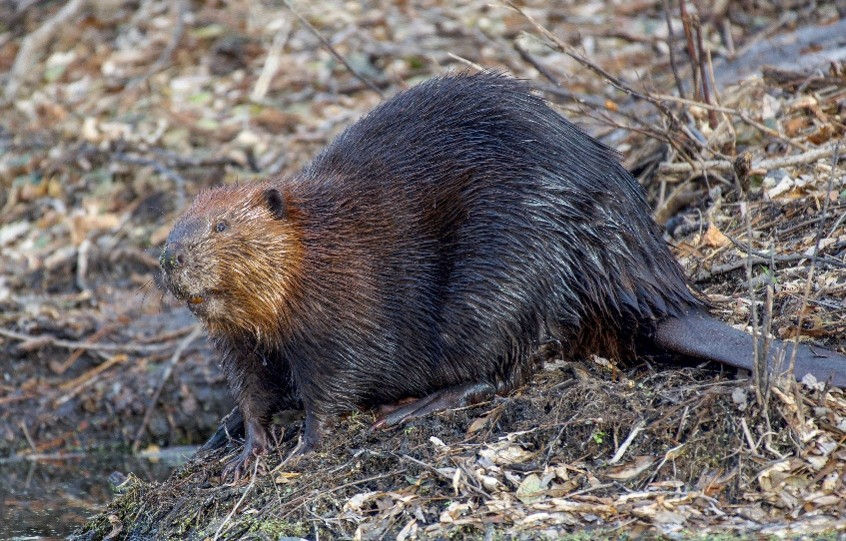
Those beaver-built reaches were messy in the best ecological sense — braided channels, willow flats, and chains of ponds that spread water across the valley floor instead of hurrying it downstream. And that soggy complexity is where most of the life exists. Across the arid West, wetlands have been vanishing and now cover only about 2 percent of the land, yet they support about 80 percent of its biodiversity. California has lost roughly 90 percent of its historic wetlands, and Colorado, Idaho, and Nevada have each lost more than half. When we restore a stream into a clean, fast channel, we're often restoring it to a condition that only exists because the beavers were removed first.
The great unbuilding
Starting in the 1600s, the fur trade turned beavers into currency — their dense underfur made the felt hats that were non-negotiable European fashion for two centuries. Trappers were thorough, and Colorado's high country was part of it: the first large American trapping outfit to work the upper Arkansas, led by Auguste Chouteau and Jules DeMun, was here by 1815 (more than sixty years before Salida or Leadville existed). They continued trapping until Spanish troops, who then claimed the Arkansas as their border, arrested the party and marched them to Santa Fe. By the mid-1800s the trade collapsed, partly because silk had replaced felt and partly because there simply weren't enough beavers left. Mark Beardsley, the Salida-area ecologist we'll come back to, puts it like this: the beaver was wiped out much like the bison.
With the beavers gone, dams blew out and went unrepaired, ponds drained, water tables dropped, and streams cut down into narrow channels — a process called incision that drains the surrounding wetlands like pulling a plug. An entire mode of Western hydrology came apart before anyone thought to measure what it had been.
In modern times, the animals have started to come back. Trapped down to maybe a hundred thousand by 1900, beavers have since rebounded to somewhere between 10 and 40 million — nobody knows precisely, and estimates vary widely — but that's still a fraction of historic numbers. However, a recovered population is not a recovered landscape. The dam-builders are back; the dammed, water-holding landscape mostly is not.
Nature's engineers
Ecologists have a precise word for animals like the North American beaver: a keystone species, one that holds up a disproportionate share of the ecosystem around it. More specifically, beavers are ecosystem engineers — they physically rebuild their habitat instead of just living in it. (Humans are, awkwardly, near the top of that same short list.) Beardsley, who has spent years studying the high-country streams around here, says it in plainer terms: other than us, beavers may be the best animal at reshaping the world to suit themselves — and a startling number of other species have organized their lives around the wet, messy places beavers make. Colorado Parks and Wildlife now uses these terms to describe beavers in its 2026 Beaver Conservation and Management Strategy.
How a pile of sticks builds a water table

A beaver dam slows moving water. Slow water spreads sideways onto the floodplain and soaks in, lifting the water table and recharging the shallow aquifer under the valley floor. Think of that floodplain as a sponge: every spring it soaks up snowmelt, and all summer it gets wrung out. The more water the sponge holds, the longer the stream keeps flowing after the snow is gone. Beaver complexes fatten the sponge — which is exactly our problem in a snowmelt-fed system like the Arkansas, where water leaves the high country too fast in spring and runs short by late summer.
Geomorphologist Joe Wheaton points out that a healthy stream is supposed to be a little messy and inefficient. A channel full of wood, rock, and beaver dams holds water back and lets it linger; a straightened, "efficient" channel flushes it downstream and out of reach. Slowing water down turns out to be one of the most useful things you can do to a Western stream, it shaves the top off flood peaks in the wet season and props up flows in the dry one, cushioning flood and drought at the same time.
You can build one with fence posts
You don't have to wait for beavers, either — you can imitate them. Restoration crews build beaver dam analogs, or BDAs: lines of wooden posts woven with branches that mimic a beaver dam, slow the water, and often convince real beavers to move in and take over maintenance. The results can be almost comically cost-effective. On Birch Creek in Idaho, rancher Jay Wilde's stream had been drying up by mid-June for years. In 2015–16 he and his partners relocated nine beavers and built 26 BDAs; within three years the beavers had added 149 dams of their own, the creek ran about 42 days longer into the summer, and native trout in the ponded stretches were many times more abundant than before. Wilde's out-of-pocket cost was a couple hundred dollars in fence posts.
Where creeks are too dry or too steep for beavers, crews use simple stacked-rock structures — "Zeedyk structures," after restoration expert Bill Zeedyk — to do similar work. In the Gunnison Basin here in Colorado, a long-running collaborative has built close to 2,000 of these low rock dams. At treated sites, wetland plant cover jumped about 160 percent in four years (versus roughly 15 percent where nothing was done), and remote cameras have logged more than a million images of elk, sage grouse, and everything else piling into the greened-up meadows. It's low-tech, low-cost, and once water starts doing the work, largely self-sustaining.
Right here on the Upper Ark
Just up Fourmile Creek near Buena Vista, ecologist Mark Beardsley of EcoMetrics, working with Envision Chaffee County and Colorado Open Lands' Riparian Reconnect project, have been doing beaver mimicry since 2017: building beaver-style dams to rebuild wetlands and lure real beavers back to finish the job. The original hook was sediment. Too much of it washes down into the Arkansas, smothering fish and aquatic insects and silting up downstream reservoirs — and it turns out the best way to catch that sediment is to rebuild the beaver wetlands that trap it. Using old aerial photos to find where beavers once worked, Beardsley identified 22 former beaver sites in Chaffee County that are ripe for restoration, with plans to move several forward. The approach has drawn interest from some of the largest water providers on the Front Range, a sign it's being taken seriously well beyond the county line.
Along Trout Creek, a riparian zone that Civilian Conservation Corps crews replanted and dammed by hand back in 1933 is still wet and green today — in no small part because beavers found the work and have been maintaining it ever since.
And right now in wildfire season, it’s worth looking at how beaver dams can function inside a burn. When ecohydrologist Emily Fairfax and a colleague mapped thousands of beaver dams inside recent Western wildfire burns, they found that beaver-dammed stretches stayed green while the surrounding country turned to charcoal — across fires of every severity, the beaver areas essentially didn't burn. It's the phenomenon Wheaton summed up after a 2018 Idaho megafire left a lush green ribbon standing along a line of beaver ponds: "water doesn't burn." Those wet reaches become refuges — the place animals flee to when the hills are on fire, and the place life spreads back from afterward. And the benefit outlasts the flames: beaver ponds and BDAs trap the ash, soot, and debris that post-fire storms flush downstream, protecting water quality when a scorched watershed would otherwise choke its own streams. Early studies of burned creeks are already finding healthier water and richer insect life below beaver dams than above them.
What we’re doing and how you can help
As Ben Goldfarb says in the quote at the beginning of this post, right here and now in our very own watershed is where this work is imperative. The pressures bearing down on the Upper Arkansas — shrinking snowpack, water that leaves too fast in spring, longer and hotter fire seasons — are close to the exact problems a beaver-rich headwaters used to manage on its own, for free. The animal we trapped out of these valleys happens to be very good at nearly everything we now need this landscape to do: hold water later into the season, buffer floods, trap sediment, store carbon, and keep a little green in the middle of a burn. BDAs are no silver bullet, and not every stream is a good candidate. But as restoration tools go, few are this cheap, this durable, or this willing to work the night shift on our behalf.
Calling our community: Central Colorado Conservancy and the Upper Arkansas Watershed Partnership (UAWP) is creating a local Beaver Working Group! We’re interested in working with local organizations who are already doing beaver work in our watershed (and those who want to), ecologists, and volunteer beaver-enthusiasts. We’re also supporting some of our staff to train as Beaver Coexistence Professionals through The Beaver Institute’s BeaverCorps Program. The training includes non-lethal beaver management and LTPBR (low-tech process-based restoration) techniques.
And we want landowners to know that any beaver work we do will respect and protect any and all water rights.
If you’re interested in getting involved, contact Nathan Ward at info@uawp.org or Jo Thompson at jo@centralcoloradoconservancy.org.
That’s it for this month. Next month we get into the policy side: why Colorado Parks and Wildlife rolled out a statewide Beaver Conservation and Management Strategy in 2026, what it actually says, and what it could mean for the streams — and the landowners — of the Upper Ark.
Next in the series: Colorado Catches Up — Inside CPW's Beaver Strategy.
References and Citations
Goldfarb, Ben. Eager: The Surprising, Secret Life of Beavers and Why They Matter. Chelsea Green, 2018.
Randall, Brianna. "Simple hand-built structures can help streams survive wildfires and drought." Science News, March 26, 2021. https://www.sciencenews.org/article/stream-survival-beaver-dam-simple-structures-wildfires-drought
Smith, Max R. "Leave it to Beavers: Cross-species collaboration may help restore wetlands." Chaffee County Times, May 4, 2025. https://www.chaffeecountytimes.com/news/leave-it-to-beavers-cross-species-collaboration-may-help-restore-wetlands/article_df2a4838-aded-4c0a-97de-07975c9dc6d5.html
Jordan, Chris E., & Emily Fairfax. "Beaver: The North American freshwater climate action plan." WIREs Water 9, no. 4 (2022): e1592. https://doi.org/10.1002/wat2.1592
Stewart, Erin. Beavers Buffering Blazes: The Potential Role of Castor canadensis in Mitigating Wildfire Impacts on Stream Ecosystems. Undergraduate thesis, 2020.
Colorado Parks and Wildlife. Beaver Conservation and Management Strategy. Published March 2026. https://engagecpw.org/beaver-conservation-and-management-strategy
Beaver Institute: BeaverCorps Program. https://www.beaverinstitute.org/professional-info/beavercorps-program/


For those comparing ad networks, jzzmedia.com presents a straightforward summary of its regional alliance. The focus on premium publishers and performance metrics could be a good starting point for advertisers weighing their options in Asia.
Beavers play such a vital role in restoring the hydrological balance of our watersheds. For those interested in documenting similar observations or maintaining a personal record of ecological shifts, a dedicated space for personal notes can be a helpful way to track environmental changes over time.