
“I can’t jump over that!” Thinking Like A Trout
- Feb 19
- 3 min read
By Nathan Ward, Upper Arkansas Watershed Partnership Coordinator
Imagine you are a trout in the Arkansas River. It doesn’t much matter what kind of trout you are, a Brown or a Rainbow. You are a trout, swimming in the cold water looking for the perfect place to spawn. And then you smell it, or feel it, or whatever trout do, and you turn west into the South Arkansas River on the south side of Salida, and swim rapidly into this clear, clean tributary. It feels perfect, right up until the time your trout nose runs straight into a wall of concrete. Confused, you let the current carry you back a bit and then swim back upstream again. Whack! Trout nose into the concrete again and again. You try jumping over it, but only the most athletic trout will ever make it. Maybe you’re not that trout. If not, your spawning journey into the South Ark ends, almost before it ever began. There will be no spawning here for you.
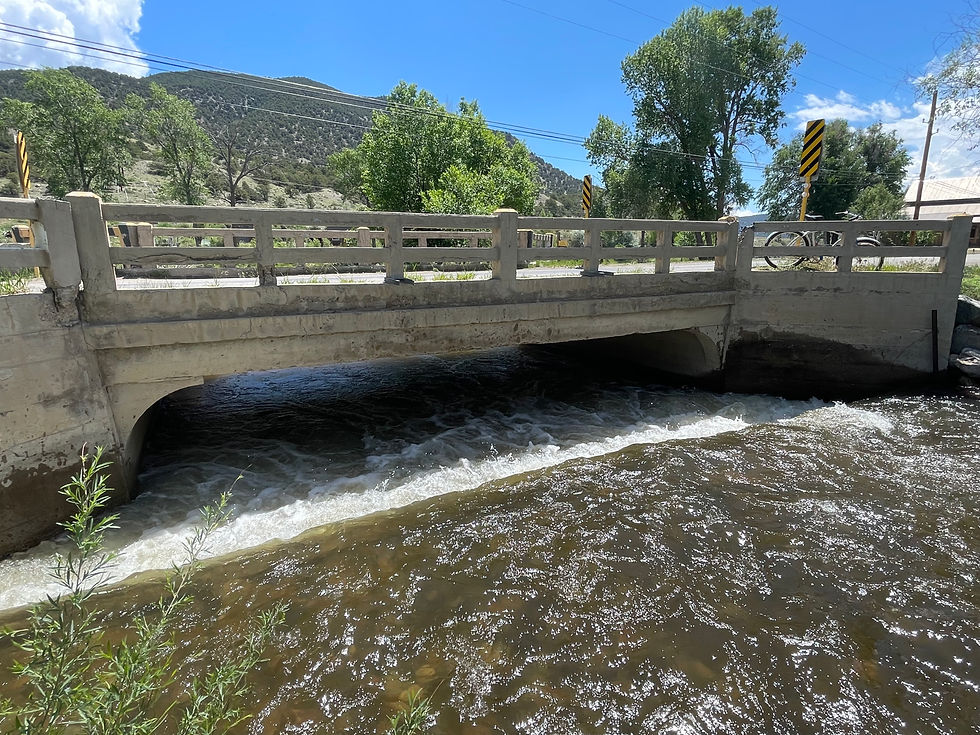
Just a few yards upstream of the confluence of the Arkansas and South Arkansas rivers, a small
concrete dam spans the river, effectively blocking almost all trout trying to swim into this important tributary of the Arkansas River. Call it a lowhead dam or call it a weir, this structure was originally used as a water measuring site, and it has blocked spawning here for decades. It’s a trout tragedy!
Luckily, this tragedy may have a happy ending soon. Central Colorado Conservancy, a key partner in the Upper Arkansas Watershed Partnership (UAWP), has been working on a river enhancement plan for the 1.2 mile reach of the South Arkansas River above the confluence. In addition to creating better instream fish habitat with pools, ripples and big woody debris, the plan calls for the removal of this concrete weir which will open the South Arkansas River up to trout spawning from the mainstem for the first time in decades.
It sounds like a simple thing - just remove the weir and let the trout swim upstream. However, in reality, removing a weir in a river is a difficult process that requires surveying, engineering, planning, fundraising, permitting, contracting, monitoring, and more. This weir removal project was originally slated to be part of a larger city project, the replacement of the road bridge over the South Ark on County Road 105. However, when bids for the bridge replacement came back over budget, the City of Salida decided to tackle the weir removal as a separate project.

The Conservancy, in partnership with the UAWP, Collegiate Peaks Chapter of Trout Unlimited, City of Salida, Two Rivers Homeowners Association, Colorado Parks and Wildlife, U.S. Army Corps of Engineers, HydroGeo Designs, National Park Service - Rivers, Trails and Conservation Assistance program, and others have all worked together to move the project forward.
Late last year, David Lady, Public Works Director for the City of Salida, presented the project to the Salida City Council, and they generously agreed to fund this restoration project completely in the 2026 budget. Before runoff in the spring, the local river restoration firm HydroGeo Designs will remove the weir and install a series of rock vanes to maintain the grade of this stretch of the river. Trout will be able to move upstream, and down, over and through the small drops created by the rock vanes.
It’s a winning project in many ways. The project will enhance the look of the river for the neighboring landowners. The contractor is local and will purchase all the materials from local vendors, so all of the taxpayers’ money will stay in the community. And the trout, well the trout may benefit most of all. Fish scientists from Colorado Parks and Wildlife believe the South Arkansas River will become an important spawning ground for the Gunnison River Rainbow Trout, a species stocked in the Arkansas River and resistant to whirling disease.
Of course, this concrete weir is not the only barrier to fish passage in the South Arkansas River. With the UAWP, the Conservancy also recently helped get a new irrigation structure modified to allow fish passage. The Conservancy’s Ricki Garden is also working with Nathan Ward to create a map of the South Arkansas River to identify fish passage barriers from source to confluence. This map will help us plan future projects to remove more barriers, and we then hope to apply this mapping exercise to other nearby tributaries of the Arkansas River.
Join us later in the year as we walk and explore other reaches of the South Ark to gather data for this project. We’ll be hiking on our feet, but we’ll be thinking like trout.


I read the “Thinking Like A Trout” post and it uses the idea of imagining you are a trout swimming up a river to show how fish respond to habitat, currents, and obstacles in rivers like the Arkansas and South Arkansas, which helps people understand river health and why clean water and good habitat matter for wildlife. It reminded me of a time I was overwhelmed with deadlines and had to take my online Statistics class help service so I could finish my work and still enjoy simple outdoor moments. That taught me how support and planning make hard work easier to handle.